
Right After a Collision: Immediate Safety Steps
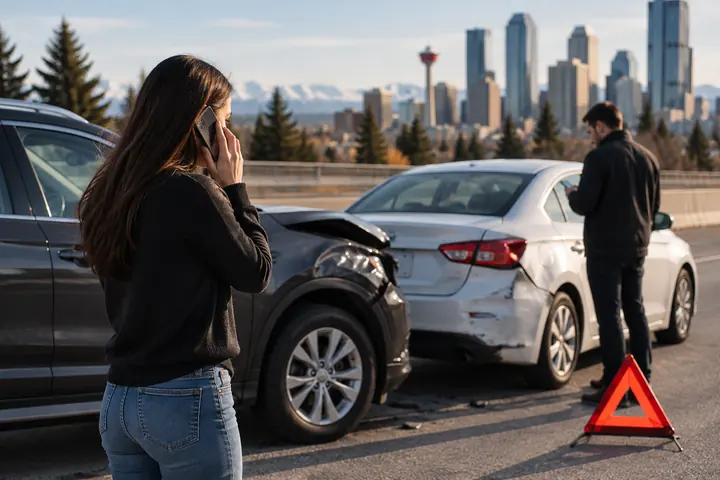
The first actions after a collision affect both the safety of everyone at the scene and the legal record of what happened. After car accident what to do comes down to a fixed sequence - do these in order, not in parallel:
- Do not leave the scene - leaving after a collision involving injury or significant damage is a criminal offence under Canada’s Criminal Code; stay until police release you or until the reporting obligation is otherwise fulfilled
- Call 911 if anyone is injured, if you suspect criminal activity such as impaired driving, or if vehicles are blocking traffic in a way that creates an immediate hazard
- Do not move injured people unless they’re in immediate danger from fire, traffic, or another active hazard - moving someone with a spinal injury can make it significantly worse
- Do not stand between vehicles while assessing damage - a second collision can happen without warning, particularly on highways or in low-visibility conditions
- If your vehicle is drivable and no one is seriously injured, move it to the shoulder or a nearby side street to clear the road; if the vehicle can’t be moved, turn on hazard lights, place warning triangles or flares if you have them, and move everyone to a safe distance from traffic
These five steps apply whether this is what to do after a minor car accident or something more serious. Use this as your what to do after a car accident checklist regardless of severity. The sequence doesn’t change, and it reflects what to do after a car accident in Alberta under provincial reporting and insurance rules.
Do Not Admit Fault or Settle at the Scene
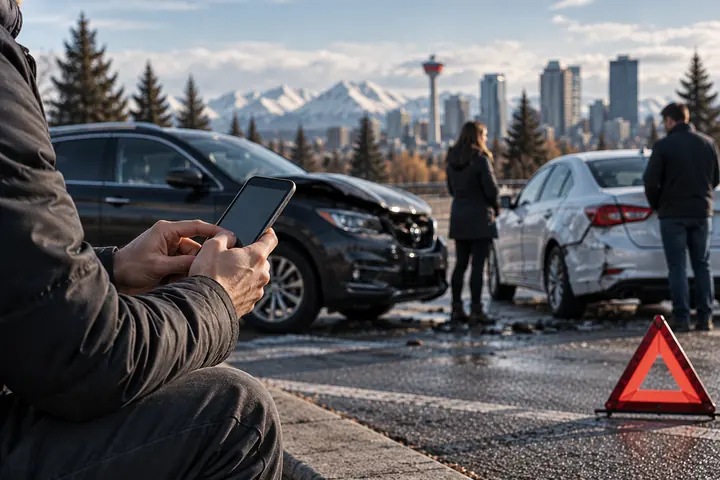
Don’t admit fault. Don’t discuss who caused it. Don’t accept cash. These three things are consistent across every Alberta government source, the AMA, and legal practice in this province - and they matter because fault determination in Alberta runs through insurers and courts, not through what drivers say to each other while standing next to damaged vehicles.
Filing a police report doesn’t raise your insurance rates on its own. Being found at fault for an accident can. Those are two different things. Don’t avoid reporting because you’re worried about premiums, since the legal exposure for failing to report when required is worse. If you’re unsure what to do after car accident, reporting it properly is one of the first steps to get right.
Don’t sign anything at the scene, including documents handed to you by a tow truck operator. Don’t agree to settle with cash or to pretend the accident didn’t happen.
A verbal agreement at the scene waives your right to future claims - including for injuries that don’t show up for 24 to 72 hours.
What to do after a car accident not your fault begins with protecting the record, not trying to resolve anything informally on the roadside.
When Do You Need to Report to Police in Alberta?
The $5,000 Property Damage Threshold
Alberta’s government has confirmed through its annual review that the $5,000 property damage collision threshold remains unchanged for 2026. This is the combined estimated damage across all vehicles and property involved - not just your vehicle. If the total appears to reach or exceed $5,000, reporting to police is required.
| Situation | Police Report Required? | What to Do |
|---|---|---|
| Combined damage is $5,000 or more | Yes | Report the collision to police or a Collision Reporting Centre |
| Anyone is injured | Yes | Call 911 and seek medical attention |
| Driver has no valid licence or insurance | Yes | Report the collision to police |
| Suspected criminal activity | Yes | Call 911 |
| Public property is damaged | Yes | Report the collision regardless of damage amount |
| Damage is under $5,000 and no other reporting requirement applies | Generally no | Exchange information and notify your insurer |
Important: The $5,000 threshold applies to the combined estimated damage to all vehicles and property involved, not just your vehicle. Separately, as of January 1, 2024, any damage to public property - traffic signals, street signs, guardrails, or similar infrastructure - must be reported regardless of the dollar amount involved.
The AMA independently corroborates the $5,000 figure. What to do after car accident alberta guidance applies to when police reporting decisions are made at the scene. It’s an estimate made under pressure - when in doubt, report.
How to Report
Call 911 if anyone is injured, if the vehicle isn’t drivable and is blocking traffic, or if you suspect criminal activity. For collisions that don’t require emergency response but still meet the reporting threshold, attend a police station or Collision Reporting Centre and get a report number - you’ll need this for your insurance claim.
In Edmonton, the Edmonton Police Service operates two confirmed physical Collision Reporting Centre locations (North and South). In Calgary, Alberta’s online Report My Collision tool at alberta.ca handles eligible collision types including two-vehicle collisions as part of a current pilot program.
Exchanging Information After a Car Accident in Alberta
Knowing what to exchange in a car accident is a legal obligation under Alberta’s Traffic Safety Act, not just a practical courtesy. It’s also a key part of what to do after car accident situations. If you’re wondering what to do after getting in a car accident, start here. Exchange the following with every other driver involved before anyone leaves the scene:
- Full name and contact information - phone number and address if requested
- Driver’s licence number - check that the name on the licence matches what the driver has told you
- Insurance company name and policy number - the insurance card should be in the vehicle
- Vehicle registration and licence plate number - make, model, year, and colour of every vehicle involved
- Contact information from any witnesses who saw the collision - names and phone numbers while they’re still present
Take photos of the accident scene before moving the vehicles if it’s safe to do so. Capture the damage from different angles, licence plates, road and weather conditions, skid marks, traffic lights, and nearby signs. If someone is injured and can’t provide their information, a passenger may be able to provide it instead.
If the other driver refuses to exchange information or drives away - a scenario many people search as what to do if someone hits your car and doesn’t stop - write down their licence plate, vehicle details, colour, and direction of travel. Then report the incident to police, regardless of how much damage occurred.
Notifying Your Insurance Company
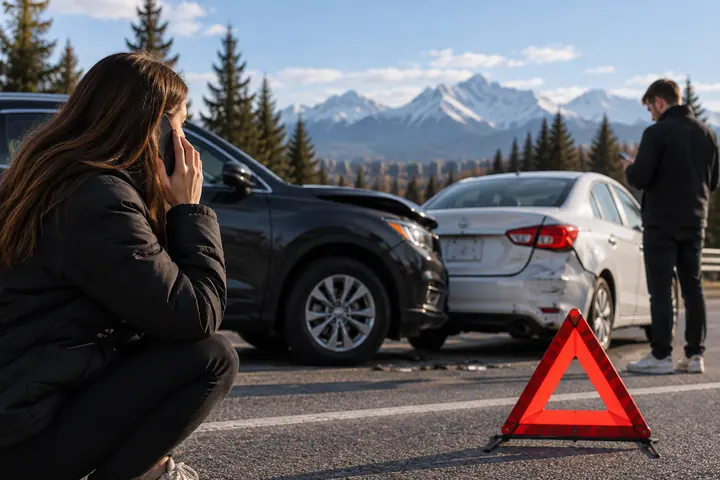
Notify your insurer as soon as reasonably possible after the accident, regardless of who was at fault and regardless of whether you plan to make a claim.
Most Alberta auto policies require prompt notification, and delays can complicate a claim even when you have a valid one and did nothing wrong.
When deciding what to do after a car accident, calling your insurer early should be near the top of the list.
When you contact your insurer, describe the accident honestly and accurately: location, time, road conditions, what happened, and the extent of any injuries and damage you observed. Do not minimize injuries at this stage - some symptoms aren’t immediately apparent and can worsen over the following days. Keep records of all correspondence with your insurer from this point forward.
Police officers and Collision Reporting Centre staff do not determine fault. Fault is assessed separately by each insurer under Alberta’s Fault Determination Rules, based on their own investigation. That assessment can be disputed if there’s a disagreement - through the insurer’s internal review or, where appropriate, through legal action.
Direct Compensation for Property Damage (DCPD) in Alberta
Since January 1, 2022, Alberta’s Direct Compensation for Property Damage regime has changed how vehicle damage claims work (source: alberta.ca). Under DCPD, a driver who was not at fault for the collision claims vehicle damage through their own insurer rather than the at-fault driver’s insurer.
This is a change from the previous process and means that even in a clear-fault situation, your insurer handles your vehicle repair. DCPD doesn’t cover all situations - if the other driver was uninsured, for example, the process is different. What to do after a car accident not your fault in terms of property damage now runs through your own policy under DCPD in most cases.
Getting Your Vehicle Repaired
You have the right to choose the auto body shop that repairs your vehicle after an accident in Alberta. Your insurer can recommend a shop but generally cannot require you to use one - responsibility for the quality and outcome of the repair rests with the vehicle owner, not the insurer, when you select the shop independently. Obtain at least one written estimate before authorizing any repairs.
Verify that the shop is licensed and in good standing before agreeing to any work. If your insurer recommends a direct repair facility and takes on responsibility for the outcome, that arrangement should be clearly documented in writing before repairs begin.
Watch Out for Predatory Towing
The AMA identifies predatory towing - sometimes called “accident chasers” - as a real risk after collisions in Alberta. These are third-party tow operators who monitor police scanners and arrive at accident scenes uninvited, often applying pressure on shaken drivers to agree to towing and storage arrangements before those drivers have had a chance to think clearly or check prices.
You have the legal right to choose who tows your vehicle and where it goes, unless police have directed a specific tow company. Do not sign any towing or storage authorization without asking for rates in writing first. Do not authorize any repair work at a facility you haven’t independently chosen, and don’t sign anything at the scene that you haven’t read and understood.
Section B Accident Benefits: Getting Medical Treatment Covered
Section B no-fault benefits are available through your own auto insurer regardless of who caused the accident.
They cover medical and rehabilitation treatment up to $50,000 for most injuries, and lost-income support typically at the lower of $400 per week or 80% of your pre-tax average weekly earnings.
These benefits apply whether you were the driver, a passenger, a pedestrian, or a cyclist involved in the collision.
For Sprains, Strains, and Whiplash (WAD I or II)
For whiplash-associated disorder Grade I or II injuries - sprains, strains, and similar soft-tissue injuries - Alberta’s Diagnostic and Treatment Protocols allow a primary health care practitioner (physician, chiropractor, or physiotherapist) to bill the auto insurer directly without requiring prior insurer approval (source: alberta.ca).
Timely notification of the claim to the insurer is required. This means you can start treatment through a primary care provider without waiting for the insurer to approve coverage in advance - a meaningful practical difference in the first days and weeks after a collision.
For Other Injuries
For injuries outside the WAD I/II category, or where private or group health coverage is available, that coverage is accessed first. Once private coverage is exhausted or doesn’t apply, the auto insurer’s Section B benefits are the next resource:
- See your primary health care practitioner for assessment and treatment as soon as possible - a medical record from shortly after the accident is foundational to any benefit or tort claim
- File an injury report with police if applicable and obtain a report number
- Complete and submit the AB-1: Notice of Loss and Proof of Claim form to your auto insurer - this is the formal application process for Section B accident benefits (source: alberta.ca)
- Wait for the insurer to review and respond to the claim
Keep an Emergency Kit in Your Vehicle
The AMA recommends keeping a prepared emergency kit in your vehicle year-round, particularly given Alberta’s winter driving conditions. A kit doesn’t prevent accidents, but it reduces risk and discomfort when one happens in a remote area or in cold weather:
- First aid kit with basic supplies
- Tire repair kit or portable inflator
- Warning triangles or emergency flares
- Flashlight and spare batteries
- Warm blanket and gloves
- Non-perishable food and bottled water
- Jumper cables or a portable battery booster
- A small shovel for winter months
- A copy of your insurance documents and roadside assistance contact information
A kit that’s in the vehicle when you need it is significantly more useful than one you planned to put together eventually.
If You Were Injured, What Happens Next
If you were injured in the accident, the next steps are important. Make sure the collision is properly reported, exchange information with the other driver, notify your insurer, and get medical attention as soon as possible. Section B benefits can help cover medical treatment and other expenses regardless of who was at fault.
If another driver caused the accident through negligence, you may also have the option to pursue a personal injury claim. Alberta’s Limitations Act generally gives you two years from the date of the accident to start a claim, although specific circumstances can affect how the deadline applies.
If you were injured in Calgary or elsewhere in Alberta, car-accident-lawyer-calgary.ca can connect you with an independent lawyer licensed by the Law Society of Alberta. The service is free, with no obligation and nothing to sign before your initial conversation.
Frequently Asked Questions
Does reporting a car accident raise my insurance rates?
Reporting itself doesn’t raise your rates - being found at fault for the accident can. Not reporting when required can lead to fines or demerit points instead. Filing a report when you’re not at fault creates a record that supports your claim.
What information do I need to exchange after a car accident in Alberta?
Name and contact information, driver’s licence number, insurance policy details, vehicle registration and licence plate, and photos of the damage and scene if possible. Get contact information from any witnesses too. What to exchange in a car accident is a legal obligation under Alberta’s Traffic Safety Act for reportable collisions.
Do I have to report a minor accident with no injuries?
What to do after a minor car accident with no injuries and combined damage under $5,000: police reporting generally isn’t required, though you may still choose to report for insurance documentation. Reporting is required regardless of damage amount if an unlicensed or uninsured driver was involved, or if any public property was damaged.
Can I choose my own repair shop?
Yes. You have the right to choose the auto body shop that repairs your vehicle. Your insurer can recommend a shop but generally cannot require you to use one.
What if a tow truck shows up that I didn’t call?
Be cautious. Ask whether police authorized the tow, request written rates before agreeing to anything, and don’t sign any documents under pressure. This is a sign of the predatory towing practices the AMA specifically warns about.
What if I’m not sure whether my injuries need medical attention?
See a primary health care practitioner even if you feel fine at the scene. Whiplash, concussion, and soft-tissue injuries frequently don’t produce clear symptoms for 24 to 72 hours after a collision. An early medical record is important for any Section B or tort claim that follows.
Are you a law firm?
No. car-accident-lawyer-calgary.ca is not a law firm and does not provide legal advice. This guide is for general information only. If you were injured, car-accident-lawyer-calgary.ca can connect you with an independent lawyer licensed by the Law Society of Alberta, free of charge.