
The Parking Lot 50/50 Myth: And Why It’s Not True
You’ve probably heard it before: parking lot accident fault always splits 50/50, no matter what happened, because there are no real traffic rules in a parking lot.
It’s one of the most repeated pieces of misinformation out there, and it’s not true.
This portal isn’t a law firm - it connects people hurt in Alberta car accidents with independent lawyers licensed by the Law Society of Alberta, free to use, no obligation.
This page walks through where the myth comes from, how parking lot accidents fault actually gets determined using Alberta’s official framework, the most common parking lot scenarios and their typical outcomes, and what to do if you’re ever in one of these situations yourself.
It’s written specifically for parking lot accidents Alberta drivers deal with, so the rules described apply under provincial law.
Where the Myth Comes From
It’s easy to see why people assume a parking lot accidents alberta case defaults to a coin flip.
There’s usually no painted lanes, no traffic lights, everyone’s moving slowly, and it can feel like a lawless zone compared to a regular street.
But none of that changes the fact that drivers still owe each other a duty of care - the same basic rules of the road still apply, they’re just applied to a different layout.
Part of what reinforces the myth is that people rarely dig into how fault determinations actually work until they’re dealing with one firsthand. Without a clear framework to point to, “50/50” becomes the easy default explanation - even though a specific, government-published set of rules exists to settle most of these questions.
How Fault Is Actually Determined in Alberta
Alberta’s Direct Compensation for Property Damage (DCPD) Regulation
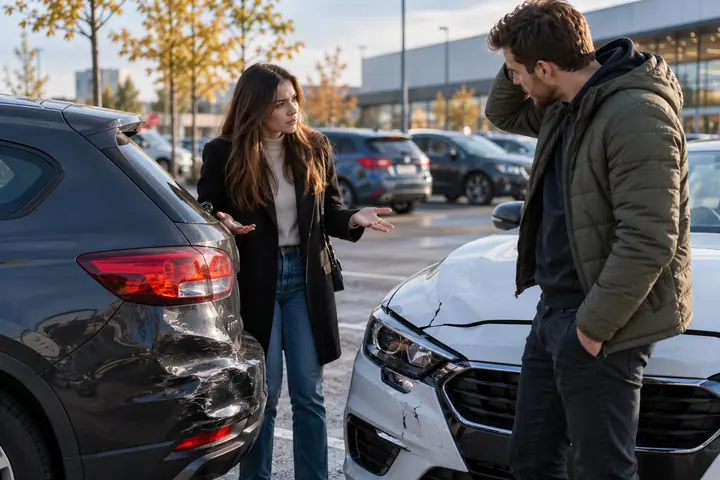
Since January 1, 2022, every Alberta driver has been covered under the Direct Compensation for Property Damage Regulation, Alta Reg 132/2021. DCPD determines which insurer pays for vehicle damage based on an assigned fault percentage - if you’re found 25% at fault, for example, DCPD generally covers the remaining 75% through your own insurer.
This system means you’re not necessarily waiting on the other driver’s insurer to sort things out before your own vehicle gets repaired. Your own policy responds according to the fault percentage assigned, which is part of why an accurate fault determination matters - it directly affects what portion of the repair cost your insurer covers.
When a Scenario Isn’t Clear-Cut
Not every parking lot accident lines up neatly with a pre-set scenario. When that happens, claims specialists generally look at Alberta’s Traffic Safety Act and how similar situations have been resolved in the past to work out fault individually, rather than defaulting to a fixed answer.
This individualized approach means the specific facts of a collision end up mattering more than a blanket rule ever could. The details a claims specialist typically looks at include:
- Who was moving - whether one vehicle was stationary, slowing down, or already travelling through the lane
- Who had the right of way - for example, a driver on the main thoroughfare versus one leaving a feeder lane or parking space
- Whether a sign was posted - a stop or yield sign at the intersection point changes which rules apply
- How the vehicles were positioned - where each car ended up and where the damage is located on each vehicle
It’s also why disputes sometimes arise between drivers who each remember the sequence of events differently.
Common Parking Lot Scenarios and Who’s Typically at Fault
Alberta’s Automobile Insurance Rate Board (AIRB), the government body responsible for these determinations, publishes an official chart covering common accident scenarios, including a section specifically for parking lots. If you’ve had an accident in parking lot areas like a mall or grocery store, here’s how the most common situations shake out:
| Scenario | Typical Fault Outcome |
|---|---|
| A vehicle leaves a feeder lane and enters the main thoroughfare without yielding | The driver who failed to yield is 100% at fault |
| A vehicle backs out of a parking space without yielding | The driver backing out is 100% at fault |
| There’s a posted sign at the intersection point | Standard rules for intersections with signage apply |
| No sign is posted and the road type can’t be determined | Rules for uncontrolled intersections apply - which can, in some cases, result in a 50/50 split |
Someone searching for who has right of way in a parking lot is usually looking for exactly this: the vehicle already travelling on the main thoroughfare generally has the right of way over one entering from a feeder lane or backing out of a space. That’s one of the core parking lot accident rules Alberta insurers apply when assigning fault.
The logic behind these rules mirrors how fault works on regular roads: a vehicle already in motion on a through lane generally has priority over one merging, entering, or reversing into that same space. The same principle usually decides an accident in parking lot lanes, where the driver backing out or pulling in is often the one found at fault.
If You Hit a Parked Car
According to the AIRB chart, if you hit a legally parked vehicle, you’re 100% at fault. There’s a narrow exception involving illegally parked vehicles outside a municipality, but for the vast majority of parked car hit in parking lot situations, the outcome is straightforward.
This one tends to surprise people less than the others, since it lines up with common sense. A stationary vehicle parked where it’s supposed to be generally can’t be found responsible for a collision it had no part in causing. It’s also a good example of who has right of way in a parking lot, because a legally parked car isn’t competing for space at all.
What If Both Cars Were Backing Up at the Same Time?
This one’s genuinely murkier. AIRB doesn’t have a dedicated scenario covering two vehicles backing up simultaneously and colliding - only a scenario where one vehicle is backing up and the other isn’t. So it’s not accurate to claim this situation is automatically 50/50; it’s more realistic to say it will likely be assessed case by case, based on the specific facts.
Factors like each driver’s speed, how much warning either had, and whether one vehicle had already committed to its path before the other started moving can all influence how a claims specialist ultimately assesses a situation like this. That’s quite different from a parked car hit in parking lot case, where the stationary vehicle is almost never found at fault.
What to Do If You’re in a Parking Lot Accident in Alberta
If you’re dealing with a car hit in parking lot situation right now, here’s the general sequence to follow, based on the parking lot accident rules Alberta drivers are expected to know:
- Check for injuries and call 911 if anyone needs help
- Avoid admitting fault at the scene, even informally
- Take photos of the damage, where the vehicles ended up, and any signage or markings nearby
- Exchange information with the other driver
- Get contact details from any witnesses
- Notify your own insurer as soon as you reasonably can
Photographing the scene before anything gets moved matters more than people tend to assume. Parking lots don’t have the same fixed reference points as a regular intersection - no painted lane markings to point back to later - so photos of exactly where each vehicle ended up can end up being the deciding piece of evidence if fault becomes disputed.
When You’re Required to Report to Police
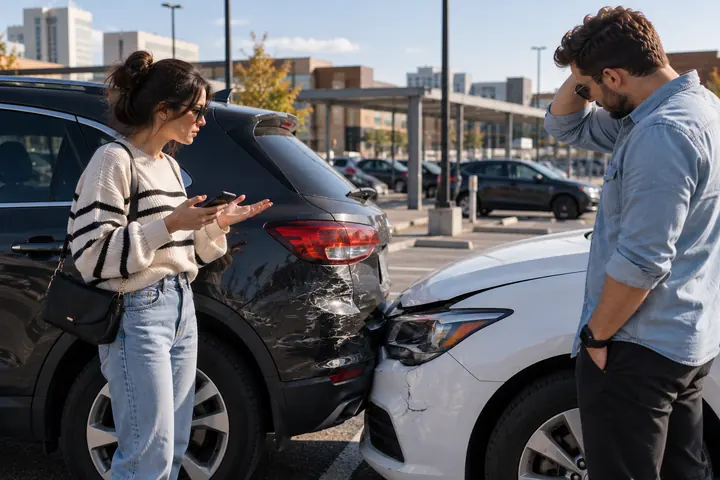
A report is generally required once damage passes a set dollar threshold, or if anyone’s injured - confirm the current amount with local police, since sources vary slightly on the exact figure. If the other driver left without leaving their information, that’s a parking lot accident hit and run situation and generally needs to be reported regardless of the damage amount.
A lot of people wonder whether a parking lot accident no police report situation is even legally fine to leave as-is. If the damage is minor and stays under the threshold, and no one’s hurt, you may not be required to report - but confirming this with your insurer is still worth doing before assuming nothing needs to happen.
Even when a report isn’t strictly required, filing one can still be worth the time. It creates an official record that can matter later if the other driver’s account of events changes, or if damage turns out to be more extensive than it first appeared. A parking lot accident no police report situation can quickly become a dispute about what actually happened.
If You Hit a Parked Car and Can’t Find the Owner
If you hit someone hit my car in parking lot and left situations from the other side - meaning you’re the one who caused the damage and the owner’s nowhere around - you’re required to leave a note with your name, phone number, driver’s licence number, and licence plate information.
Don’t just drive off. Our Hit-and-Run Accidents in Alberta guide covers what happens if you don’t, in more detail than we’ll get into here.
Is Parking Lot Damage Covered by Insurance?
Your Own Collision Coverage
For a parking lot accident insurance claim to cover your own vehicle’s damage regardless of fault, you generally need collision coverage on your policy. Where the other driver is identified and found at fault, DCPD kicks in and your own insurer handles the claim based on the assigned percentage.
Without collision coverage, repairing your own vehicle after an accident where you’re found partially or fully at fault can mean paying out of pocket for your share, even while the other driver’s damage is handled through DCPD on their end. It’s worth checking exactly what your own policy includes before assuming everything is automatically covered.
If the Other Driver Can’t Be Found
If the other driver drove off and wasn’t identified, this crosses into hit-and-run territory.
See our Hit-and-Run Accidents in Alberta and Collision Reporting Centre Alberta guides for how that process works and what compensation options might still exist.
In these cases, the usual question of is parking lot accident 50 50 doesn’t really apply, since the driver who left can’t share fault with you if they’re never found.
How Our Matching Service Works
Tell Us What Happened
Give us a short description of what happened: where it took place, what the damage looked like, and whether the other driver was identified. The details of your parking lot accident Alberta case help us match you with a lawyer whose practice fits your situation.
We Match You With a Lawyer From Our Alberta Network
We connect you with an independent lawyer licensed by the Law Society of Alberta who handles motor vehicle claims across the province - Calgary, Edmonton, Red Deer, Lethbridge, and everywhere in between. Every lawyer in the network is checked for current licensing and practice focus.
Speak Directly With the Lawyer: Free, No Obligation
You get a free consultation, directly with the lawyer, not a screener. Ask about how fault is likely to be assessed in your specific parking lot accident Alberta case and what your options look like.
Decide How to Move Forward
No pressure either way. Whether you were hit by someone backing out of a parking space or the other driver claims you were at fault, you can retain the lawyer, get a second opinion, or handle it yourself. The matching service itself never costs you anything.
Why Use This Portal After a Parking Lot Accident
Vetted, Independent Network
Every lawyer in the network is independently licensed by the Law Society of Alberta, with motor vehicle and personal injury claims as their primary practice area.
Free to Use, No Obligation
The matching service is free to use, and consultations are typically free too. If you retain a lawyer, many work on contingency - the exact terms get worked out directly with them.
Fast Matching
Most people are matched within one business day. If there’s a deadline coming up, flag it in the intake form and we’ll treat it as urgent.
About This Page
Reviewed for Accuracy: This page is reviewed periodically by our editorial team against current Alberta legislation and the official AIRB fault-determination framework, and updated whenever the rules change.
We Are Not a Law Firm
This is a lawyer-matching service, not a law firm. We don’t give legal advice or legal representation, and nothing here should be taken as legal advice for your specific situation.
How We’re Compensated
Using this portal is free for injured people. We may get a referral fee from a lawyer in our network if a match turns into a client relationship - that fee comes from the lawyer, never from you, and it doesn’t change your settlement, what the lawyer charges, or who you get matched with.