

Reporting Your Claim
The first thing to know about any car insurance claim after a collision in Alberta: you must notify your own insurer, regardless of who caused the accident and regardless of whether you’d prefer to settle things privately with the other driver.
This is a condition of most Alberta auto policies, not just a suggestion. Failing to report when required can affect your coverage even when the accident wasn’t your fault.
What you are not legally obligated to do is give a recorded statement to the other driver’s insurance company.
You can decline their request or wait until you feel ready - ideally after speaking with a lawyer, particularly when injuries are involved.
Consistent with guidance from alberta.ca and independent insurance sources, that right exists and is worth knowing before anyone from the other insurer calls you.
What Happens After You Report a Claim
You’re Assigned a Claims Adjuster
After you report the collision to your own insurer, a claims adjuster is assigned to your file. The adjuster contacts you to gather details about the accident - where it happened, what vehicles were involved, what damage occurred, and whether anyone was injured.
Be accurate and honest in these conversations. The adjuster may follow up with additional questions as the investigation proceeds. The initial account you give becomes part of the official claim file, and it can matter later if the details of the accident are ever disputed.
Your Vehicle Damage Is Assessed
Vehicle damage is assessed either through an appraiser your insurer sends or through a body shop of your choosing. You have the right to choose the repair facility - your insurer can recommend a network of approved shops but generally can’t require you to use one. The responsibility for the quality of the repair rests with you when you choose the shop independently.
If the repair cost exceeds the vehicle’s value, the vehicle may be declared a total loss. Total loss vehicles are typically covered under Section C of the policy - the vehicle’s market value minus the deductible.
Repairs
Once the damage assessment is complete, repairs can proceed. Get a written estimate before authorizing any work. Verify the shop’s credentials before committing.
If your insurer manages the repair through a direct repair program and takes responsibility for the outcome, confirm that arrangement in writing before work starts.
Keep all receipts and documentation related to the repair - these matter if the claim or the quality of the repair becomes disputed later.
If You Were Injured: Forms and Documentation
An accident benefit claim for injury in Alberta involves official Government of Alberta forms. These are the three primary documents used in injury claims:
- AB-1 Notice of Loss and Proof of Claim Form - the main application form for accident benefits; submitted to your own insurer to formally open the injury benefits process
- AB-2 Treatment Plan Form - completed by your treating health care practitioner within 10 business days of the accident; documents the proposed course of treatment and must be submitted to the insurer
- AB-1A Claim for Disability Benefits Form - the income-replacement application; a physician completes the medical portion confirming the disability that prevents work
Getting the AB-2 submitted within the 10 business-day window is a practical priority for an accident benefit claim. Delays in that submission can create friction in getting treatment coverage approved.
For whiplash-associated disorder (WAD) Grade I or II injuries, a primary care practitioner - physician, chiropractor, or physiotherapist - can bill the auto insurer directly under Alberta’s Diagnostic and Treatment Protocols without prior insurer approval, provided the claim has been notified promptly.
Direct Compensation for Property Damage (DCPD)
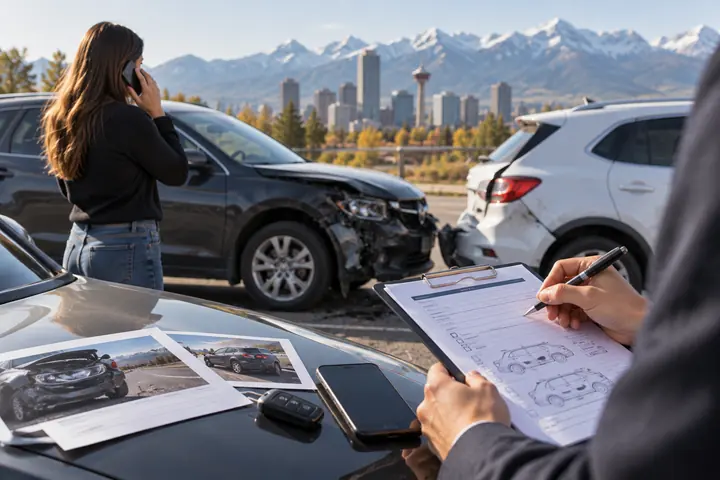
Since January 1, 2022, Alberta’s Direct Compensation for Property Damage system changed where the vehicle damage claim goes in a not-at-fault situation. Under DCPD, a not at fault insurance claim for vehicle damage runs through the driver’s own insurer rather than the other driver’s.
Before 2022, a not-at-fault driver would typically pursue vehicle damage from the at-fault driver’s insurer - that’s no longer the standard approach. How fault is divided affects how a not at fault insurance claim is split between DCPD and collision coverage within your own policy. If the other driver was uninsured, the DCPD process differs and other coverage sources may apply.
A finding of fault - even partial fault - is recorded on your driving and insurance record through a system called Autoplus. This can affect future premiums with any insurer that accesses that system.
Two points worth noting: first, at-fault findings are recorded even for partial responsibility, not just full fault; second, the Autoplus record can apply even if you weren’t the one driving - if someone else drove your vehicle with your consent and was found at fault, that finding can attach to your record as the vehicle owner.
Common Myths About Car Accident Claims in Alberta
Many people approach the insurance claim process for car accidents with assumptions that cost them. The table below addresses the most common ones:
| Myth | Reality |
|---|---|
| Being partly at fault means no Section B benefits and no claim | Partial fault doesn’t affect Section B benefits - they’re available regardless. A tort claim can still proceed, reduced proportionally by your share of fault |
| Minor accidents don’t need to be reported | Even if injuries seem minor, report the collision - whiplash and other soft-tissue injuries often take 24-72 hours to appear clearly |
| Pain and suffering compensation isn’t available | It is available, subject to Alberta’s Minor Injury Regulation for qualifying injuries - as of June 2026, the approximate MIR cap is $6,306 (Preszler Injury Lawyers, sourced June 16, 2026; subject to annual adjustment - confirm current amount before publishing) |
| Medical documentation doesn’t matter if you feel okay | Insurers can dispute the connection between the accident and symptoms if no early medical record exists - get assessed even without obvious injury |
| The at-fault driver’s coverage is always enough | Alberta’s mandatory minimum third-party liability coverage is $200,000 (Insurance Bureau of Canada) - for serious injuries, this can fall well short of the actual losses |
| The 2-year limitation period is rigid and always starts from the accident date | Exceptions exist for minors (clock may start at age 18) and delayed-discovery injuries (clock may start from when the injury was reasonably discovered) - relying on these exceptions without legal advice is risky |
| The claim process wraps up quickly | Disputed fault or serious injuries can extend the process to months or years |
| The first settlement offer has to be accepted | It doesn’t. The first offer is typically not the final position - particularly when injuries are still developing or documentation is incomplete |
| Online calculators can tell me what my claim is worth | No tool can account for injury classification, documentation quality, fault percentages, and both policies’ coverage limits - variables that determine value in any individual car claim insurance situation |
How to Claim Insurance for a Car Accident in Alberta
The insurance claim process for car accidents in Alberta runs in a specific sequence. Skipping steps or getting the order wrong creates problems later:
- Report the accident to police when required - requirements depend on injuries, property damage extent, and whether a vehicle needs to be towed; confirm current requirements through local police service
- Report to your own insurer as soon as reasonably possible - this is a policy condition, not optional
- Exchange information with other drivers at the scene - driver’s licence, insurance details, licence plate, contact information
- Seek medical attention even without obvious symptoms - a medical record from shortly after the accident matters significantly for any accident benefit claim
- Submit the AB-1 Notice of Loss and Proof of Claim to your insurer to formally open the injury benefits process
- Have your treating practitioner submit the AB-2 Treatment Plan Form within 10 business days of the accident
- If income replacement is needed, submit the AB-1A Claim for Disability Benefits Form with the medical section completed by your physician
- For vehicle damage, proceed through the DCPD process with your own insurer if another driver was at fault
- Consider whether a bodily injury claim alberta against the at-fault driver is also available - this runs parallel to Section B and has its own 2-year limitation period
Knowing how to claim insurance for a car accident before you need to file one makes the actual process considerably less stressful when a collision happens. This guide on how to claim insurance for car accident situations in Alberta walks through each step.
If Your Claim Is Denied or Delayed
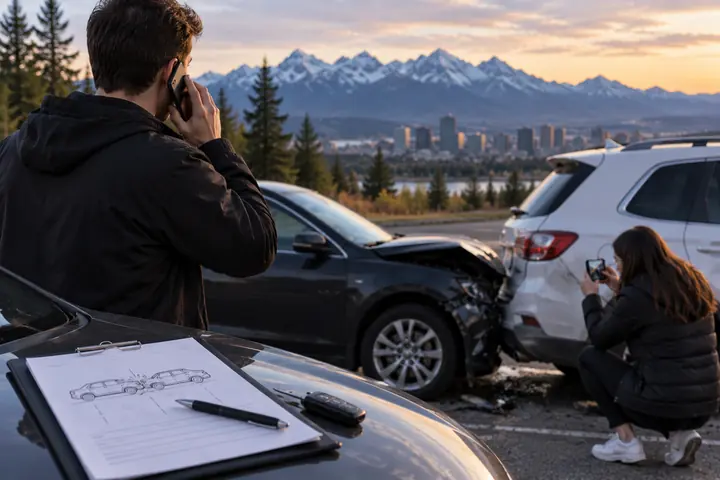
An insurer can dispute the amount of your injury settlement or the classification of your injury under Alberta’s Minor Injury Regulation. Insurers can also delay treatment approvals or deny specific benefit items. A denial or delay on a car claim insurance doesn’t end the options available to you.
An independent lawyer can review both your own policy and the at-fault driver’s policy, identify coverage sources the insurer may not have raised, and advise on whether the classification or amount being offered is appropriate for your bodily injury claim alberta. For Section B disputes specifically, the Dispute Resolution Office handles these matters rather than the courts in most cases.
How Long After an Accident Can You Make a Claim?
The general limitation period for car accident claims in Alberta is 2 years under Alberta’s Limitations Act. That clock typically runs from when the injured person knew - or reasonably ought to have known - about the injury, its cause, and that a legal claim was warranted. For delayed-discovery injuries, the clock may start from the date the connection was made, not the accident date.
For minors, the limitation period may not begin until the person reaches the age of 18. The car accident insurance claim time limit question is fact-specific - assumptions about when the clock started are one of the more common ways people inadvertently put claims at risk. Confirm your actual deadline with a lawyer as early as possible.
If You Need Help With Your Claim
Section B benefits and the tort claim process run on different timelines, involve different documentation requirements, and are subject to different rules. Many people also wonder can a car insurance company deny a claim under either track, and the answer is yes, especially when deadlines or documentation requirements aren’t met. car-accident-lawyer-calgary.ca is not a law firm.
It connects people dealing with car accident insurance claims in Calgary and across Alberta with independent lawyers licensed by the Law Society of Alberta - free to use, no obligation, nothing to sign before the first conversation.
Insurance claim help car accident alberta situations are exactly what the matching service is designed for - someone who knows both tracks and can review the specific facts of your situation.
FAQ
Do I have to talk to the other driver’s insurance company?
No. You’re not legally obligated to give a statement to the other driver’s insurer. You can decline or wait until you feel ready, ideally after speaking with a lawyer.
Will filing a claim raise my insurance rates?
Being found at fault, even partially, is recorded and can affect future premiums. Reporting a collision itself is generally required and is treated differently from being found at fault.
What if the at-fault driver’s insurance isn’t enough to cover my losses?
Alberta requires a minimum of $200,000 in third-party liability coverage, which can fall short for serious injuries. You may be able to turn to your own policy or other coverage sources to make up the difference.
Can I get compensation for pain and suffering?
Yes. The amount depends on your injuries and how they affect your life. Minor injuries may be subject to a cap under the Minor Injury Regulation; more serious injuries are not.
Can an online calculator or AI tool tell me what my claim is worth?
Not reliably. Claim value depends on factors like injury classification, documentation quality, and insurance coverage limits - variables a general online tool can’t properly weigh for your specific case.
Are you a law firm?
No. car-accident-lawyer-calgary.ca is not a law firm and does not provide legal advice. It connects you with independent lawyers licensed by the Law Society of Alberta, free of charge.